
Data decay: the silent drain on UK business
Every UK business leader knows that customer data is a core asset. Not to be dramatic, but data is the lifeblood of your business. So, what happens when that data quietly starts to rot? Let’s just say it ain’t pretty!
To maintain a healthy business, data cleansing and CRM database maintenance has to be an always-on activity – no negotiation. But in the real world, data does go unchecked and left to decay. And data decay is costing UK organisations millions every year. From lost sales opportunities to compliance headaches, poor data management quietly chips away at productivity and profit.
At Rocket CRM, we work with small and medium-sized businesses across the UK to help them make the most of Microsoft Dynamics 365, and that means helping them combat data decay by ensuring the data procedures, rules and habits that keep information accurate and up-to-date are in place from day one. And poor data management is more common than you might think…
The scale of the data decay problem in the UK:
In the UK, data decay isn’t just a technical issue; it’s a national business challenge. Here’s some unpalatable stats that should have you concerned.
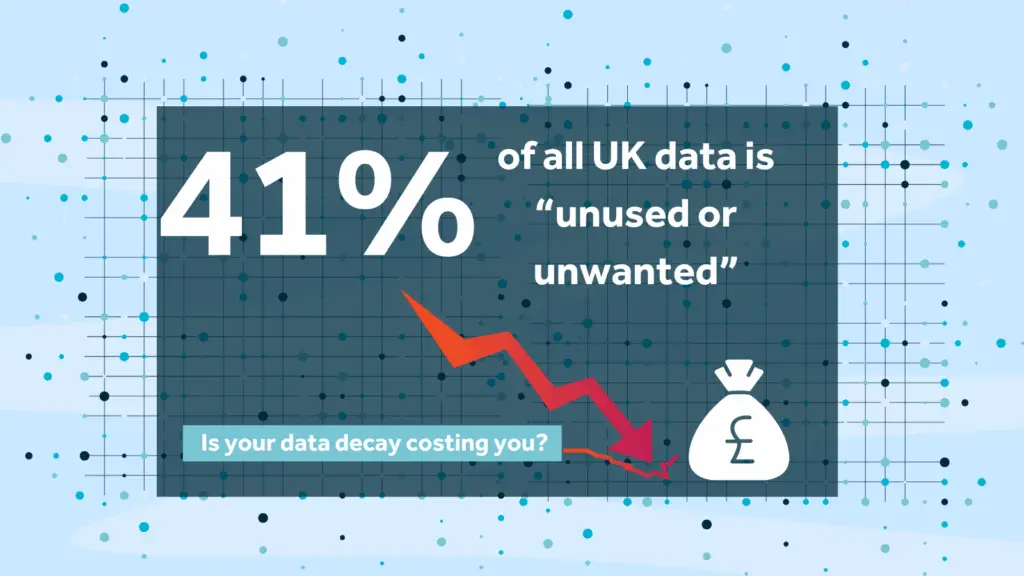
• 41% of all UK data is “unused or unwanted”, creating unnecessary storage, security and cost burdens *
• Data decays at an average rate of 30% per year as employees change jobs, companies restructure, and contact details become outdated.**
• Organisations lose around $12.9 million (about £10.5 million) per year on average due to poor data quality and management.***
• More than a quarter of IT professionals admit they review their company’s data estate only once a year or less ****
When you combine this with the fact that most modern businesses now handle huuuuge volumes of digital information, the risk compounds quickly. Incomplete, duplicated or obsolete data doesn’t just waste time; it drives bad decisions and results in ineffective sales, marketing and operational efforts.
The data decay wake-up call
The landscape around data quality and retention is tightening – so brace yourself! The Data (Use and Access) Act 2025 represents the biggest shake-up of UK data law since GDPR. It aims to simplify data sharing, support AI innovation and reduce administrative red tape, but it also puts the spotlight on responsible data management.
Under the UK GDPR and ICO guidance, businesses must ensure data is:
• Accurate
• Relevant
• Not kept longer than necessary
Whilst we don’t want to bog you down in duller than dishwater detail, there are some important things to note:
The Information Commissioner’s Office (ICO) specifically recommends that organisations adopt clear retention and disposal policies and regularly review stored data to maintain accuracy.
At the same time, the Office for National Statistics (ONS) has publicly committed to publishing less data but of higher quality, a clear sign of the government’s growing emphasis on accuracy over quantity.
These may be dry facts, but organisations that fail to manage their data effectively risk falling behind on compliance, performance and reputation.
Data waste isn’t just costly to your business; it’s unsustainable
And for the eco-conscious, you should also know that there’s also a growing environmental dimension. Storing unused or outdated data in cloud servers consumes vast amounts of energy. Research shows that 83% of UK IT departments now prioritise sustainability initiatives, and data waste is emerging as a key focus area.
So, reducing redundant data doesn’t just streamline operations; it helps reduce your digital carbon footprint, too. Clean data is greener data.
Why data decay accelerates in modern businesses
The modern workplace changes faster than ever before, and this means data is becoming out of date and inaccurate quicker than ever before:
• Around 30% of UK employees change jobs each year, causing constant churn in contact databases.
• Job roles and titles change due to restructures, mergers and rebrands.
• Email addresses and phone numbers change as teams adopt new systems.
Therefore, if you’re not actively maintaining your CRM, within months your marketing, sales and service teams may be working with outdated information. Email campaigns bounce, opportunities disappear, and reports become unreliable.
The real cost of poor data quality
The impact of poor data is widespread and not localised to poor marketing performance. Let’s break it down:
• Sales inefficiency: Teams spend hours chasing dead leads or calling people who left the company months ago.
• Marketing waste: Outdated contact lists mean wasted email sends, invalid ad targeting and lower engagement rates.
• Customer experience: Mistakes caused by inaccurate information, including wrong names and old details, which damage trust and loyalty.
• Operational cost: Duplicated data, manual corrections and compliance risks add up to significant internal costs.
Even the most sophisticated CRM can’t deliver value if the data feeding it is wrong.
How Rocket CRM helps you fight back
At Rocket CRM, we help UK businesses get the most from Microsoft Dynamics 365 by setting the right foundations and processes so your teams can maintain better data quality over time. Here’s how we support you in reducing the impact of data decay and turning information into insight.
1) Right-fit CRM setup and migration guidance
We configure Dynamics 365 around your processes and provide templates, field maps and import guidance so your team can prepare and load clean, well-structured datasets. You remain in control of the source data; we make the setup clear and robust.
2) Guardrails inside Dynamics 365
We implement business rules, mandatory fields, duplicate-detection settings and validation logic that help reduce common entry errors and prevent avoidable decay at the point of capture.
3) Integration and automation
We connect Dynamics 365 with the systems you already use, so information flows consistently and is less likely to diverge. Where appropriate, we configure automations that prompt users to review or refresh records on a sensible schedule.
4) User training and data ownership
People are the key to data quality. We train your teams on how and why to keep CRM data accurate, including naming conventions, lifecycle stages, ownership, and update routines. Clear roles and simple checklists improve day-to-day data hygiene.
5) Health checks and reporting
We set up dashboards and periodic health checks (for example, incomplete records by team, duplicates by object, or “last verified” dates) so you can see where data quality is drifting and take timely action.
6) Specialist partners when needed
If you require hands-on data cleansing or enrichment, we can and provide those specialist skills to coordinate the technical side (imports, mappings and testing) so the work lands cleanly in Dynamics 365.
The ROI of better data management
All of the afore-mentioned obviously takes effort, time and cost, but this investment of better data management practices WILL pay off. As the benefits of tackling data decay go beyond compliance; they translate directly into measurable performance improvements, such as:
• More effective sales teams: Time spent on real prospects, not ghosts in the CRM.
• Improved marketing ROI: More accurate targeting, higher response rates and stronger brand engagement.
• Better customer relationships: Personalised communication built on accurate data.
• Reduced costs: Less waste, fewer manual corrections and more efficient workflows.
• Sustainability gains: Leaner data means lower storage costs and energy usage.
Clients who prioritise data quality in their CRM strategy achieve stronger results across every department, from marketing to finance to operations.
Data management as a strategic advantage, not just a technical fix
Data management used to be something you did to tidy up. Now, it’s a competitive advantage.
Accurate, compliant and sustainable data isn’t just about avoiding errors; it enables faster decision-making, sharper insights and better customer experiences.
With the new Data (Use and Access) Act 2025 reshaping the rules, there’s never been a better time for UK businesses to take control of their CRM data and align with best practice.
Ready to stop the data rot?
Data will constantly evolve, but with the right processes and partners, it doesn’t have to decay and impact your sales and marketing efforts. Rocket CRM helps you keep your Dynamics 365 environment healthy, compliant and high performing. From system design and migration to user training and ongoing governance, we’ll help you protect your data’s integrity and turn it into a genuine driver of growth.
Let’s make your data work harder.
Contact Rocket CRM today for a complimentary CRM health check and discover how much value you could be losing to data decay and how to reclaim it.
About Rocket CRM
Rocket CRM is a Microsoft Dynamics 365, and a platinum Click accredited partner, helping small to medium-sized businesses and charities harness the power of scalable CRM technology. Our mission is to make powerful CRM software simple with custom-built, user-focused solutions.
Website: rocketcrm.co.uk
Podcast: RocketPod
Twitter: LinkedIn
Sources:
* IDC Global DataSphere Report – April 2023 (referenced in 2023–24 Splunk & Veritas analyses)
**Salesforce -State of Marketing – October 2022
Validity -State of CRM Data Health – March 2023
***Gartner “-Cost of Poor Data Quality – August 2021
****Dell Technologies – Global Data Protection Index – January 2023